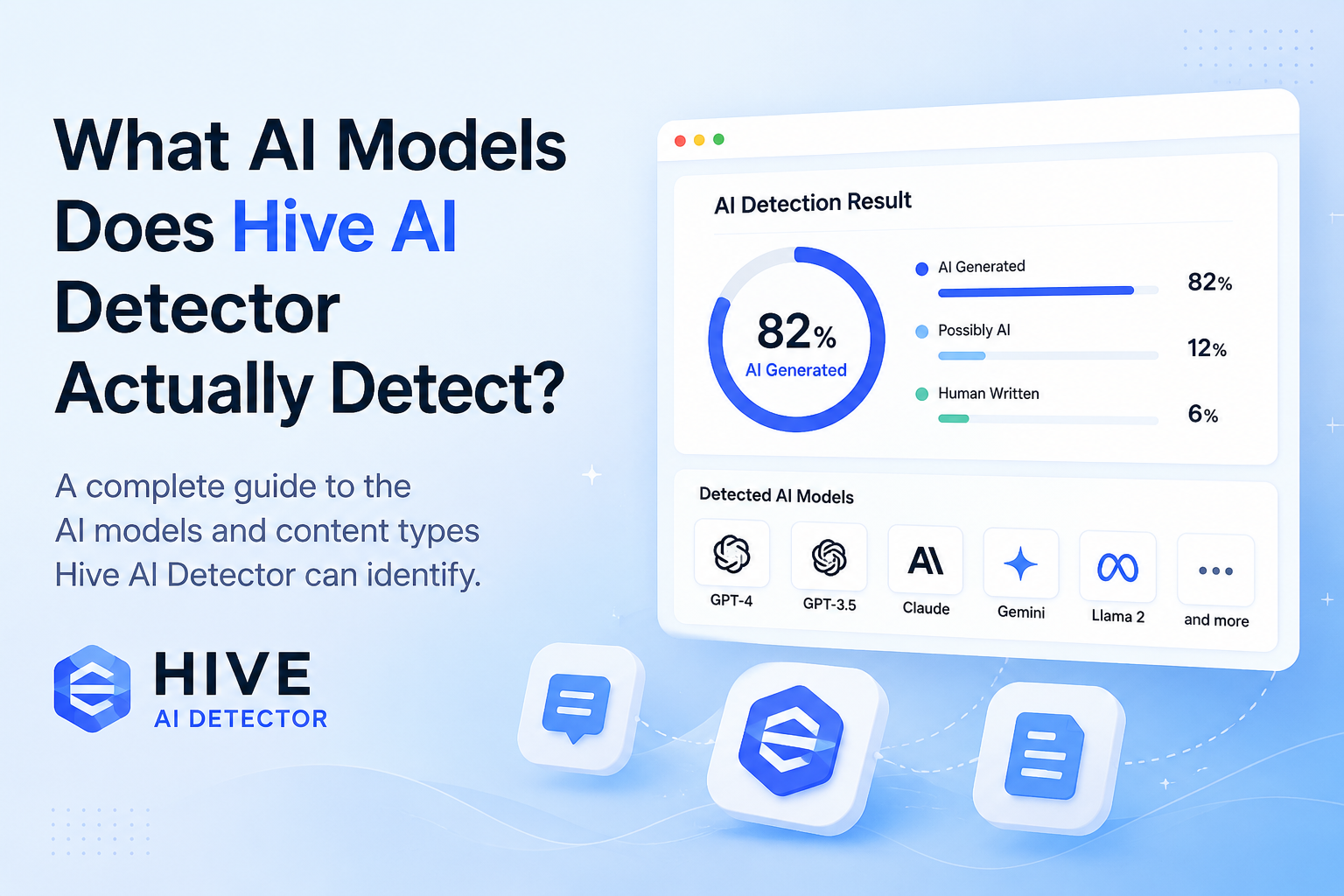
What AI models does Hive AI Detector actually detect?
What AI models does Hive AI Detector actually detect?
Asking “does it detect ChatGPT” is a start — but it’s not the full question. Models are a moving target, and the answer depends on content type, editing level, and how recently Hive updated its training data. This page gives you the full reference.
For text: Hive confirms detection of GPT-family models, Claude, and Gemini. Attribution is at the model-family level — not version-by-version.
For images and video: Hive’s API names over 100 specific generators in its response schema, including Midjourney, DALL-E, Stable Diffusion, Adobe Firefly, Flux, Sora, and Grok.
For audio: AI voice cloning detection is available via a separate endpoint with broad multilingual support.
Check your text freeThe generative engines Hive AI Detector is built to recognize.
Coverage status below is our own categorization based on Hive’s public documentation, API response schemas, and independent tests as of July 2026 — not an official Hive-published matrix.
ⓘ Coverage status reflects our reading of publicly available documentation and independent tests as of July 2026. Hive has not published an official model-coverage matrix for text. Image and video labels are sourced directly from Hive’s API response schema at docs.thehive.ai.
Hive’s image and video detection is the more granular product: the API response schema lists over 100 named generator labels. Text detection confirms major model families (GPT, Claude, Gemini) but does not publish a version-by-version breakdown in the same way.
How engine identification actually works.
AI detection tools don’t read text the way a human editor would. They operate on statistical patterns — fingerprints that different language models leave behind at a level below conscious style.
Token Probability Patterns
Language models generate text by predicting the next token. Each model family has a characteristic distribution of word choices — not vocabulary per se, but the statistical likelihood of picking one phrase over another. Detectors measure how “expected” or “low-entropy” the writing is overall.
“GPT-family output tends toward a specific hedging cadence that is measurable at scale.”
Sentence Rhythm
GPT-family output tends toward consistent sentence length and a particular cadence of clause nesting. Claude often produces longer, more structured paragraphs. Gemini writing carries different phrasing rhythms. These tendencies aren’t absolute, but they’re measurable in aggregate across a long enough sample.
“Claude-style structuring and GPT-style hedging show up as distinct signals.”
Perplexity Scoring
Perplexity measures how “surprised” a reference model is by a piece of text. Human writing tends to be more unpredictable — it includes mistakes, unusual phrasing, and genuine originality. AI-generated text is often optimized toward fluency, which produces a lower-perplexity signature that detectors learn to recognize.
“AI-optimized fluency is, paradoxically, the tell.”
Stylistic Tells
Certain phrases, transition constructions, and hedging patterns appear at higher rates in AI output from specific model families. A detection model trained on millions of labeled examples learns to weight these signals — though no single signal is definitive on its own.
“Not one fingerprint but the combination — that’s what attribution inference uses.”
Engine attribution for text is probabilistic inference, not a certainty. A high confidence score for “GPT-family patterns” means the writing statistically resembles what that model family produces — it does not mean the text was provably written by ChatGPT. Treat attribution as a best-fit estimate, not a forensic finding.
Why multi-model detection matters more than a single score.
One tool’s verdict is a data point, not a conclusion. Here’s why checking against multiple engine fingerprints gives you a stronger picture.
Hive’s text detection caught 87% of raw AI output in independent 2026 testing — a solid number, but not universal. Dedicated text detectors like Originality.ai (94%) and GPTZero (91%) scored higher in the same test. No single tool catches everything, because each one has different training data and different blind spots.
The reason is straightforward: a detector trained heavily on ChatGPT output gets good at GPT fingerprints. It may miss Claude’s longer-form paragraph rhythm. Cross-model checking covers those gaps.
Hive’s image and video detection already runs two separate models in one API call — one for AI-generated content, one for deepfakes — because neither alone is sufficient. The combined response is more informative than either output individually.
The same logic applies to text detection across tools: a document that scores low on one detector and high on two others warrants more scrutiny than one that scores low across the board. Multiple signals, not one number, are what give you a defensible assessment.
What Hive AI Detector can’t confidently identify.
Being precise about limitations is how you get useful output from any detection tool. These categories challenge Hive — and every other AI detector.
Heavily edited AI text
Once a human significantly rewrites AI output — changing sentence structure, swapping phrasing, adding personal observations — statistical fingerprints degrade. Hive’s accuracy on humanized AI text dropped to 62% in 2026 testing vs. 87% on raw output. That 25-point gap matters when text has been through revision.
Mixed-source documents
A document where some paragraphs are AI-generated and others are human-written creates a mixed signal. Detectors typically return an overall confidence score rather than paragraph-level attribution. A mostly human document with a few AI-generated sections might score low overall while still containing machine-written passages.
Non-English text
Hive’s audio detection explicitly supports multiple languages. Text detection is primarily trained and validated on English-language data. Performance on non-English text — particularly lower-resource languages — is not well-documented in available public sources and results should be treated with additional skepticism.
New and unreleased models
Any model released after Hive’s last training update lacks a robust signature in the detection system. Hive commits to updating coverage as engines “gain popularity,” but there is an inherent lag. A very new or niche model may produce output that scores as low-confidence AI or even as human-written.
Short text samples
Statistical pattern detection requires enough text to work with. A single sentence or a two-line paragraph doesn’t give any detector enough signal for a reliable result. Hive’s tool — like most — becomes meaningfully more accurate with 100+ words, and most stable above 200.
Certainty of attribution
Engine identification is a best-fit inference, not a provable finding. A result that says “likely GPT-family” means the writing pattern statistically matches GPT-style output — it is not proof of which tool was used. No AI detector can offer a legally conclusive verdict at the individual document level.
How often is model coverage updated?
The answer differs significantly depending on whether you’re asking about image detection or text detection.
Images & Video — granular and well-documented
Hive states explicitly in its API documentation that image detection models are “regularly updated to cover new major generative engines as they gain popularity.” The evidence is visible in the response schema itself: over 100 named generator labels including very recent tools like Sora 2, Veo3, and several 2025-era video generators. This is the more mature and more frequently updated side of Hive’s detection platform.
Text — general commitment, unpublished schedule
Hive’s Chrome extension description notes that the model is “regularly updated to perform well on the newest versions of Midjourney, ChatGPT, etc.” — a general commitment without a specific cadence. Independent tests from mid-2026 confirm that Hive catches output from current major text models, suggesting the training data is reasonably current, though the exact update frequency is not publicly documented.
Practically: if a major new language model launches today, expect a lag before Hive’s text detection is specifically tuned to it.