Is Hive AI Detector accurate? What the research actually shows.
Is Hive AI Detector accurate? What the research actually shows.
Type “is Hive AI detector accurate” into a search bar and you’ll get two opposite answers depending on which page loads first: a vendor blog citing a near-perfect independent study, or a forum thread describing a false positive that cost someone real trust. Both can be true at the same time, because Hive is not one detector — it’s a family of models covering images, video, and text, and the evidence backing each one is nowhere near equally strong. The image model has a genuinely independent academic study behind it. The text model, the one most people mean when they ask this question, mostly has Hive’s own numbers and a scattering of informal third-party tests. This article separates what’s been independently verified from what hasn’t, and shows exactly where the numbers come from.
What “accuracy” actually means for an AI detector
A single accuracy percentage hides two very different kinds of mistakes, and conflating them is how most AI-detector marketing gets misleading.
False positive: the detector flags human-written text (or a real photo) as AI-generated. In an academic setting this means accusing a student who didn’t cheat. In a hiring or moderation setting it means rejecting genuine work.
False negative: the detector misses AI-generated content and calls it human. This is a quieter failure — nobody gets falsely accused, but the tool didn’t do its job.
These two error types trade off against each other. A detector can be tuned to catch almost everything AI-generated by lowering its threshold for suspicion, but that same tuning increases how often it wrongly flags real human writing. Tune it the other way — require very high confidence before flagging anything — and false accusations drop, but so does the detection rate. There is no setting that eliminates both types of error at once, which is why a vendor’s single “99% accurate” headline number is close to meaningless without knowing which error rate it’s measuring and under what conditions.
This is also why 100% accuracy isn’t a realistic bar for any detector, Hive included. As detection researchers at the University of Chicago put it when evaluating this category of tool: every detector is at least slightly imperfect, and organizations have to decide for themselves how to trade off the risk of missed AI content against the risk of false accusations.
What independent testing has found
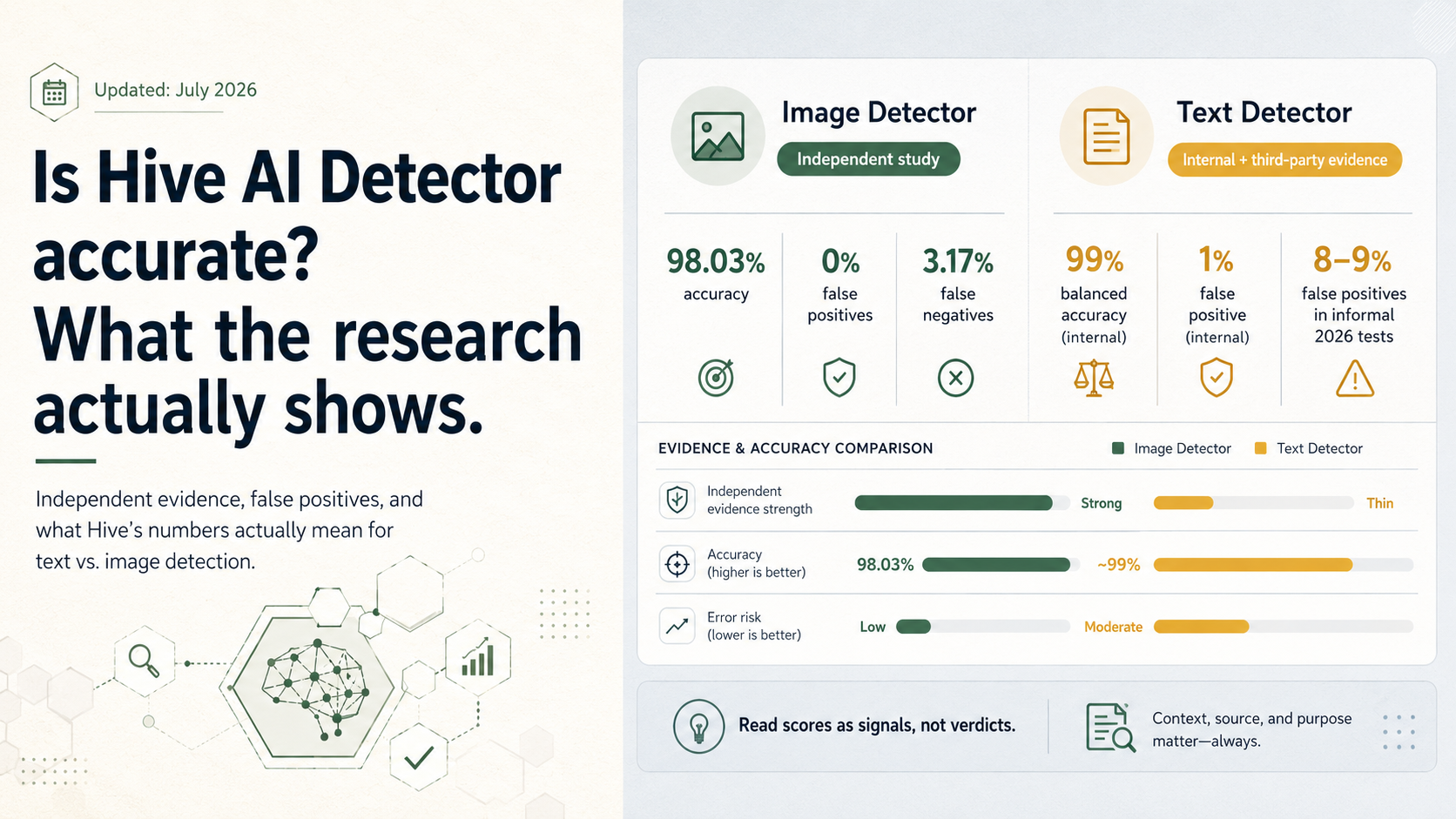
The strongest piece of third-party evidence in Hive’s favor is a 2024 study out of the University of Chicago — but it’s important to be precise about what it actually tested. Researchers Anna Yoo Jeong Ha and Josephine Passananti published “Organic or Diffused: Can We Distinguish Human Art from AI-generated Images?” (arXiv 2402.03214), comparing several automated detectors against human reviewers on the specific task of telling AI-generated images apart from human art. Hive’s image-detection model came out as what the authors called the “clear winner” among automated tools: 98.03% overall accuracy, a 0% false positive rate on human-made art, and a 3.17% false negative rate on AI-generated images. The model also held up against most image-perturbation techniques, with one notable exception — it struggled more when AI images had been processed with Glaze, a tool originally built to protect human artists’ work, not to disguise AI output.
That distinction matters because most people searching “is Hive AI detector accurate” are asking about the text checker — the one used for essays, articles, and other written content — not the image tool. The evidence base there looks different.
Hive’s own 2023 announcement of its AI-text classifier described an in-house test against 242 text passages spanning casual, technical, and academic writing, including text from non-native English writers specifically included to check for bias. On that test set, Hive reported a 99% balanced accuracy rate and a 1% false positive rate, ahead of GPTZero (83% balanced accuracy, 30% false positive rate at the time), OpenAI’s now-discontinued classifier (73% accuracy, 12.5% false positives), and Writer’s detector (46% false positives). Those are Hive’s own published test results, not an independent audit — there’s no indication a third-party research group replicated this specific 242-passage test.
The most rigorous independent text-detector research to date comes from a separate 2025 Chicago Booth working paper by Brian Jabarian and Alex Imas, “Artificial Writing and Automated Detection.” It built a roughly 2,000-passage dataset across six writing types and tested detector performance at different passage lengths and confidence thresholds. It’s a well-designed study — and it did not include Hive. The detectors evaluated were GPTZero, Originality.ai, Pangram, and the open-source RoBERTa baseline. All three commercial tools kept false positive rates under 1%, with Pangram’s close to zero; RoBERTa performed close to random guessing and was called “unsuitable for high-stakes applications.” Because Hive wasn’t part of this cohort, there’s currently no way to place Hive’s text detector on the same footing as Pangram, GPTZero, or Originality.ai using this specific benchmark.
Outside of academic studies, a handful of newer blog-run benchmarks in 2026 have tested Hive’s text detector directly, with more mixed results: one test across 40 samples reported an 8% false positive rate for Hive versus 4% for Originality.ai on the same set, and roughly 87–88% overall text accuracy — solid, but behind the highest-scoring dedicated text detectors on that same test. These are useful data points, but they’re single, non-peer-reviewed tests run by content sites rather than published academic research, so treat the specific percentages as directional rather than definitive.
Hive AI Detector vs. other detectors on accuracy
Putting these different evidence types side by side is more useful than picking one number. The ledger below focuses only on accuracy and methodology — not price or features — and notes exactly where each figure comes from.
Read across that table and the honest summary is: Hive has one strong, independent, academic-grade result to its name, and it’s for images, not text. On text, the strongest number available is Hive’s own, and the field’s most rigorous independent text benchmark to date simply didn’t include Hive in its test group.
Where Hive AI Detector’s accuracy breaks down
Every detector in this category, Hive included, gets measurably worse in a few predictable situations. Being upfront about them is more useful than pretending they don’t exist.
- Very short passages. The Chicago Booth study found that all three commercial detectors it tested lost accuracy on passages under roughly 50 words, simply because there isn’t enough writing for a statistical pattern to emerge. There’s no reason to expect Hive’s text model to be exempt from this general pattern, even though it wasn’t part of that specific test.
- Heavily edited or paraphrased AI text. Third-party testing of Hive’s text detector has flagged this as a weak spot, and it’s a known industry-wide problem — the RAID benchmark found that detectors in general are “easily fooled” by paraphrasing and unseen model outputs. Text run through a “humanizer” tool multiple times has been reported to slip past most detectors, not just Hive’s.
- Non-English or non-native-English text. This is one of the best-documented false-positive risks in the whole category — a widely cited 2023 Stanford study found earlier-generation detectors flagged 61% of TOEFL essays by non-native English speakers as AI-written. Hive says it specifically included non-native English samples in its 2023 test set to guard against this, but no independent study has since re-tested that claim at scale.
- Image perturbation tools built for a different purpose. On the image side, the University of Chicago study found Hive’s detector had more trouble with images processed through Glaze, a tool designed to protect human artists’ work from AI training — not to help AI images evade detection. It’s a genuine edge case, just not the one most people worry about.
Hive’s image detector has real independent validation behind it. Its text detector has a favorable internal test and a thinner set of third-party checks — reasonably strong on clean, unedited AI text, and less proven on short, edited, or non-English writing, same as most of the category.
How to read your own score correctly
Given all of the above, the most useful thing you can do with any AI-detector score — Hive’s included — is treat it as one input, not a verdict.
- Check the passage length first. A score on a 40-word snippet deserves far less confidence than one on a 500-word article, for the reasons covered above.
- Look at the sentence-level breakdown, not just the headline number. If a tool flags 90% of a document but the flagged sentences cluster in one paragraph, that’s a different situation than a uniform 90% across the whole piece.
- Treat borderline scores as inconclusive, not confirmatory. Scores near the middle of the range are exactly where false positives and false negatives both cluster.
- Never use a single score as the sole basis for an accusation. Hive said this itself when it introduced its text classifier: the tool is meant as a screening aid alongside human judgment, not a final decision-maker.
You can run your own text through Hive’s checker and see this breakdown directly — sentence-by-sentence, rather than a single number in isolation.
Want to see how your own writing scores, sentence by sentence?
Paste any passage into the checker for an AI-probability reading plus a full sentence-level breakdown.
Run your own checkFrequently asked questions
The bottom line
Hive’s AI-image detector has a genuine, independently authored academic study behind it, and the numbers from that study are strong. Its text detector’s best-documented accuracy comes from Hive’s own testing rather than an outside research body, which doesn’t mean the numbers are wrong — but it does mean they haven’t been checked the way the image model’s numbers have.
If you’re evaluating whether to trust a Hive score on a piece of writing, the most reliable approach is the same one that applies to every detector in this category: read the sentence-level breakdown rather than the single percentage, and treat a borderline result as a reason to look closer, not as a verdict.