AI Detector vs. Plagiarism Checker: What’s the Real Difference?
AI Detector vs. Plagiarism Checker: What’s the Real Difference?
Updated: July 2026
Most people treat AI detectors and plagiarism checkers as different names for the same thing — tools that catch “cheating.” They are not. They look at completely different aspects of a piece of writing, produce different kinds of results, and fail in entirely different ways. Mixing them up has real consequences: a student can have zero similarity score on a plagiarism check and still get flagged by an AI detector, or vice versa, and if an instructor doesn’t understand the distinction, the result can be a false misconduct accusation. Understanding what each tool actually measures is the first step to interpreting any flag fairly — whether you’re a student, an educator, or a writer.
What a Plagiarism Checker Actually Measures
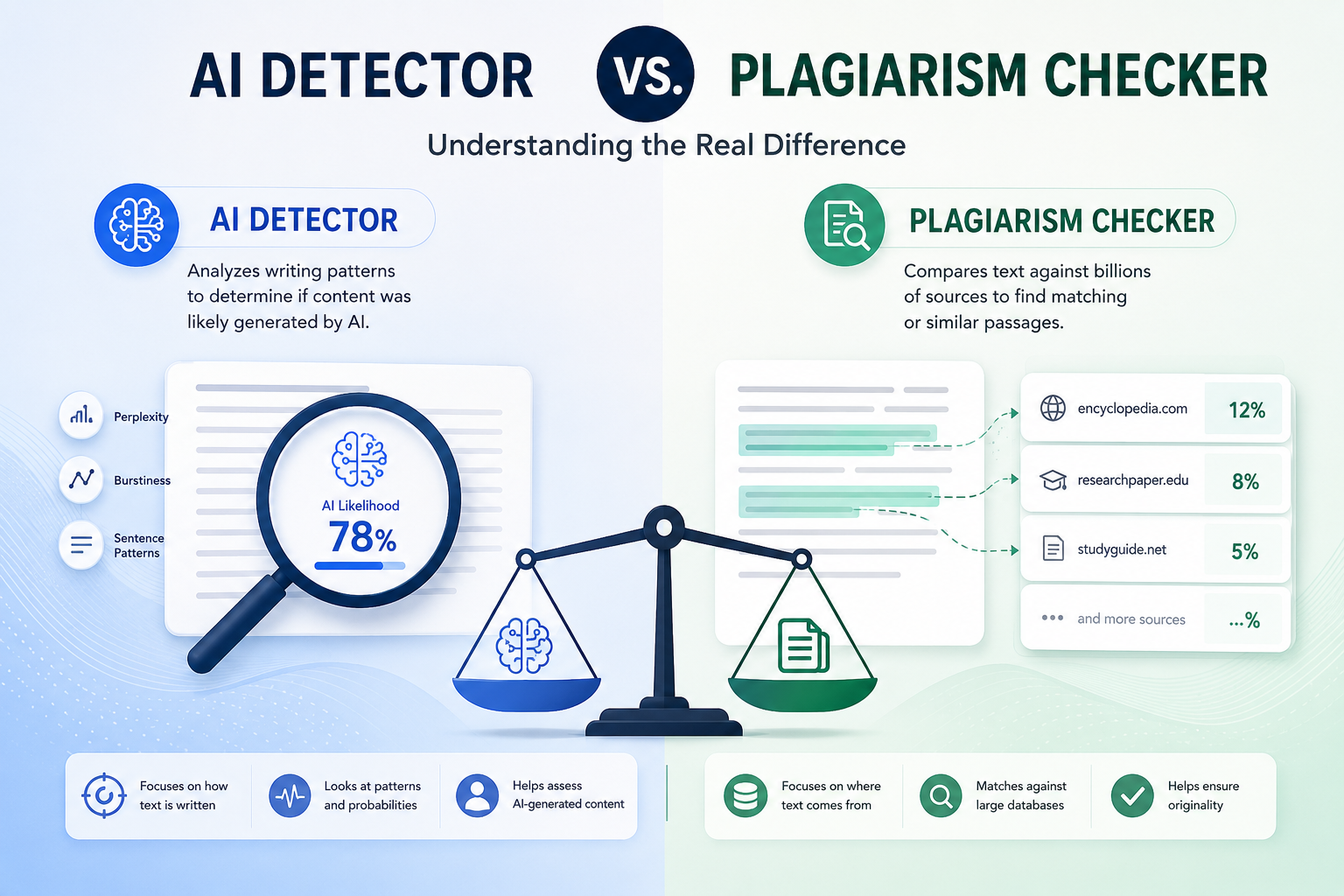
A plagiarism checker compares text against a database. That database might contain billions of web pages, academic journals, books, and previously submitted student papers — in Turnitin’s case, the database is one of the largest in the world, built from decades of institutional submissions. The tool scans your submitted text word by word, looking for sequences that match text already stored in that database.
The output is a similarity percentage — the share of your text that matches something already indexed. A 20% similarity score does not mean 20% of your paper is plagiarized. It means 20% of your text resembles content in the database, which can include correctly cited quotes, discipline-specific boilerplate phrases, your own previously submitted work, or genuinely copied passages. The similarity score is a starting point for investigation, not a verdict.
Plagiarism detection has one fundamental limitation that matters here: it can only find text that already exists somewhere in its database. Content generated entirely by an AI from scratch — with no matching source — will not show up as a plagiarism hit, because there is no source document to match against. This is why AI detection tools were built as a separate layer.
What an AI Detector Actually Measures
An AI detector does not consult a database of sources. It has no list of ChatGPT outputs to compare your text against. Instead, it analyzes the statistical and linguistic patterns of the writing itself — things like how predictable each word choice is given the words around it, how uniform the sentence structures are, and how closely the text matches what a language model would produce given a similar prompt.
Turnitin’s AI writing detection, which launched in April 2023 and has been significantly updated since, works at the sentence level. It assigns each qualifying sentence a probability of being AI-generated, then aggregates those into an overall percentage. Turnitin is explicit in its own documentation that this score is “different from and independent of the similarity score” — they are generated by completely separate models and are displayed in separate reports.
Turnitin now runs three separate detection models in parallel: one for direct AI generation, one for AI-generated text that has been paraphrased by another AI tool, and one for content processed through AI “bypassers” or humanizers. All three run on every qualifying English submission. As of August 2025, this three-model system replaced the earlier two-model setup that had been in place since July 2024.
Side-by-Side Comparison
| Dimension | AI Detector | Plagiarism Checker |
|---|---|---|
| What it measures | Statistical patterns that suggest AI authorship — predictability, phrasing uniformity, sentence-level probability scores | Text matches against a database of existing sources — web pages, journals, previously submitted papers |
| What a “flag” means | The text resembles AI-generated writing — a probability judgment, not a finding of fact | A portion of the text matches a specific source already in the database — the source is visible and citable |
| Can it point to a source? | No. There is no “source” for AI writing. The flag is statistical, not comparative. | Yes. The matched passage and original document are both shown in the report. |
| Common false-positive scenario | Structured, formulaic, or polished writing — especially from non-native English speakers or neurodivergent writers whose style triggers pattern-matching | Properly cited quotes, boilerplate terminology, self-plagiarism from previously submitted drafts |
| Typical score output | % of qualifying text predicted as AI-generated (displayed separately from similarity score) | % of text matching existing sources (similarity score) |
| Primary use case | Detecting writing that may have been generated by ChatGPT, Gemini, or similar tools without disclosure | Detecting copied, paraphrased, or uncited material from existing sources |
| Can it catch AI writing? | Yes — its purpose | No — only if the AI text was copied from an indexed source |
| Can it catch plagiarism? | No — it does not compare against source databases | Yes — its purpose |
| Scores are independent? | Yes — Turnitin’s own documentation states the two scores are completely independent of each other | |
The False Positive Problem — What the Data Actually Shows
The most consequential issue with AI detection is not its failure to catch AI writing. It’s that it can flag human writing as AI-generated — sometimes at alarming rates — and that flag can trigger serious academic consequences before any human judgment is applied.
What Turnitin itself acknowledges
Turnitin has stated in its public documentation that the AI Writing Report “may not always be accurate” and that it “should not be used as the sole basis for adverse actions against a student.” The company has previously described its target false-positive rate as under 1%, while also acknowledging that scores between 0 and 20% carry higher incidence of false positives. In July 2024, Turnitin changed its interface to suppress exact percentages in the 0–19% range, replacing them with an asterisk (*) — a direct acknowledgment that low-confidence flags were being misread as findings.
Independent testing found a different picture
A Washington Post test in spring 2023 found that original student work could be wrongly flagged — including a high school senior’s personally written essay that was partially marked as likely AI-generated. The test also showed that mixed human/AI content could confuse the system in unpredictable ways.
The University of San Diego’s research guide notes that a Washington Post investigation produced a false-positive rate of around 50% in its sample — far above Turnitin’s stated 1% target. That gap reflects how real-world conditions differ from controlled internal testing.
Non-native English speakers are disproportionately flagged
This disparity happens because AI detectors are built around perplexity — a measure of how statistically predictable word choices are. Writers working in a second language naturally choose more common, less surprising vocabulary, which makes their writing look statistically “smooth” in the same way AI output does. This is not a flaw in how those students write. It’s a flaw in what detection tools measure.
Real institutional consequences
The scale of real-world misuse became visible through reporting on Australian Catholic University. ABC News reported that ACU recorded nearly 6,000 alleged academic misconduct cases in 2024, with roughly 90% being AI-related. A substantial share were dismissed after investigation. ACU subsequently abandoned the Turnitin AI detection tool after finding it ineffective. Meanwhile, The Markup documented cases at Johns Hopkins where international students were falsely accused and had to produce drafts, notes, and research trails to clear their names — documentation that most students wouldn’t think to preserve.
Several universities have drawn their own conclusions. Vanderbilt University disabled Turnitin’s AI detector in August 2023, explicitly citing the risk of wrongful accusations. The University of Iowa advises instructors to avoid using AI detectors on student work due to their inherent inaccuracies.
Can You Fail an AI Check but Pass a Plagiarism Check?
Yes — and this is one of the most practically important things to understand about these tools. The two scores are completely independent. You can have 0% similarity on a plagiarism check and still receive a high AI writing score. You can also have high similarity and no AI flag at all.
Here’s why: a plagiarism checker looks for existing text that already appears somewhere. If you asked ChatGPT to write an essay from scratch and it generated something original — something no one has published before — there is nothing for the plagiarism checker to match against. The similarity score will be low. But the AI detector will analyze the writing patterns of that generated text and may flag it as AI-authored.
The reverse is also true. A student who copies and paraphrases from several different sources, rewording each sentence enough to avoid exact matches, may get a low similarity score on a plagiarism check while never having used an AI tool at all. The AI detector would find nothing, because the writing patterns are human. Whether that paraphrasing constitutes academic misconduct is a separate question — but the plagiarism tool may not catch it either.
What to Do If You’re Flagged
Getting flagged by either type of tool doesn’t mean you’re guilty of anything. Here’s how to respond in each case, calmly and practically.
If an AI detector flags your work
- Request the full report. Ask your instructor or institution for the specific passages flagged and the score breakdown. Turnitin’s AI Writing Report is visible to instructors and not automatically shared with students — you have to ask for it.
- Gather your writing trail immediately. Version history in Google Docs or Microsoft Word, saved drafts, outline documents, research notes, highlighted sources, emails with feedback — these are the strongest evidence of genuine authorship. Collect them before anything else.
- Explain your process specifically. Don’t just deny using AI. Walk through how you developed the argument, what sources you used, which sections you found difficult, and where you revised. A concrete reconstruction of the writing process is more persuasive than a flat denial.
- Disclose any tools you did use. Grammarly, spell-check, translation software, dictation tools, accessibility aids — document what they did and what they didn’t do. Detectors can’t distinguish between these legitimate tools and AI ghostwriting. Being transparent about permitted tools defuses suspicion.
- Know your institution’s policy. Ask to see the specific academic integrity policy on AI and what evidence standard applies. Turnitin itself states that an AI score should not be the sole basis for action. If your institution’s process doesn’t reflect that, you have grounds to request a fairer review.
If a plagiarism checker flags your work
- Look at what’s actually flagged. A high similarity score often includes properly cited quotations and field-standard terminology. Review the highlighted passages with your instructor to identify what genuinely needs attention versus what is a false match.
- Check for self-plagiarism issues. If you submitted a draft earlier in the same submission system, your own previous draft can flag as a match. This is a common source of unexpected similarity scores and is generally resolvable by explaining the submission history.
- Improve citation and paraphrasing. If the flag involves real matches that aren’t properly cited, this is a fixable problem. Work with your instructor on how to attribute the source correctly or paraphrase the passage more substantially.
Frequently Asked Questions
Get More Context Than a Single Score
One of the most consistent problems with single-score AI detection is that a number by itself tells you almost nothing useful. A 45% AI score doesn’t tell you which sentences drove it, whether it’s concentrated in your introduction or spread throughout, or whether specific phrases are the issue. Without sentence-level detail, there’s nothing concrete to act on.
Hive AI Detector runs multiple detection models against your text and breaks down the results sentence by sentence, so you can see exactly where the score is coming from rather than just a summary number. This kind of multi-model, passage-level view is what makes the difference between a score that raises questions and one that actually helps you understand — and explain — your writing.
Check your text before it’s flagged
Run your writing through Hive AI Detector’s sentence-level analysis — free, no account needed.
Check your text now →